


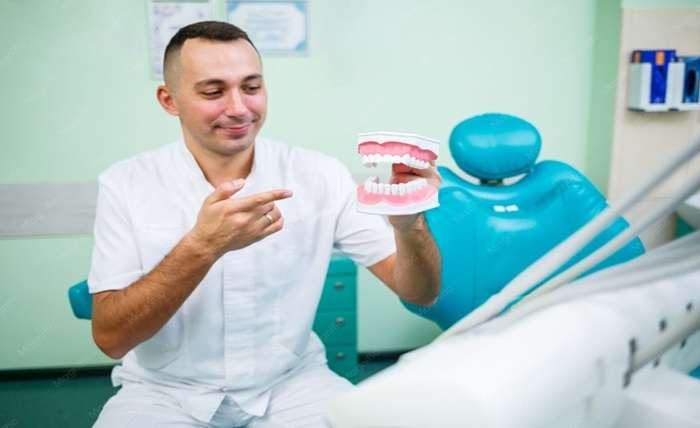
Among full-arch implant protocols, All-on-6 offers the greatest biomechanical margin. Six implants per arch rather than four spread bite forces more evenly, and they build in something All-on-4 cannot: redundancy. If one implant runs into difficulty during healing — uncommon, but not impossible — the remaining five can carry the prosthesis while it is dealt with. Antalya is one of Turkey’s busiest centres for this work, and Dental Harmony Turkey treats full-arch implantology as a central part of its international patient programme, at pricing well below UK and European equivalents.
How the Protocol Works
Six titanium implants are distributed across the arch, commonly two anteriorly and four through the posterior sections, though the precise map is dictated by the 3D CT taken on arrival. That scan does more than count available bone: it charts density, volume and the position of nerves and sinuses that determine where implants can safely go. With six anchor points supporting the bridge, there are more contact points sharing the load, and per-implant stress falls accordingly over decades of function. It is why patients with heavy bite forces, a history of bruxism, or previously failed implants are so often steered toward All-on-6 rather than All-on-4.
All-on-6 in Turkey: 2026 Price Comparison
| Country / Region | Average Cost | Notes |
| UK (per arch) | £12,000 – £20,000 | Private only; London clinics at the upper end of this range |
| Germany (per arch) | €10,000 – €17,000 | Statutory insurance rarely contributes to implant costs |
| Netherlands (per arch) | €11,000 – €18,000 | Private market only; significant Turkey demand |
| Antalya, Turkey (Dental Harmony Turkey) | £3,500 – £4,500 | Per arch, all-inclusive: implants, abutments, temporary and final prosthesis |
What the Package Covers
- A remote opinion built on whatever X-rays or CT files you already hold, before any flight is booked
- Cone beam CT imaging in Antalya, and the treatment plan signed off against it
- Removal of any failing teeth still in place, where the case calls for it
- Six titanium fixtures placed per arch
- A fixed temporary prosthesis the same day — nobody leaves the clinic without teeth
- Remote clinical support throughout the months of healing
- A second visit covering design, laboratory fabrication and fitting of the definitive zirconia or hybrid bridge
- Bite refinement and a full review once the permanent bridge is in place
All-on-6 vs All-on-4: Detailed Comparison
| Factor | All-on-4 | All-on-6 |
| Implants per arch | 4 | 6 |
| Implant angulation | Back implants angled 30–45° | Varies by bone anatomy |
| Bone volume needed | Lower — can work with less | Moderate — requires adequate distribution |
| Grafting likelihood | Often avoidable | Usually not required with adequate bone |
| Bite load distribution | Good | Superior |
| Redundancy if one implant fails | Lower | Higher |
| DHT price (per arch) | £3,000 – £3,500 | £3,500 – £4,500 |
What Patients Say Afterwards
The surgery was easier than expected. Most patients report the placement under local anaesthetic as considerably less unpleasant than they had braced for. Swelling and soreness for 3–5 days follows, and the acute phase is generally described as manageable with standard pain relief and rest.
The same-day bridge changed everything. Leaving the clinic with a fixed set of teeth on the day of surgery comes up again and again as the moment that mattered most. For people who had been managing with dentures or visible gaps for years, the psychological shift is described in far stronger terms than the clinical outcome itself.
Healing at home was uneventful. Remote check-ins with the clinical team, combined with clear written guidance on diet and hygiene during osseointegration, meant most patients felt supported through the months between visits without needing to fly back.
The permanent bridge outperformed expectations. Appearance, bite function and comfort of the final zirconia bridge are consistently rated above previous dental work done in patients’ home countries.
The Treatment Timeline
Visit 1 — allow 5–7 days in Antalya. Day one is imaging and sign-off on the plan. Surgery and the same-day temporary bridge follow on day two or three, with a post-operative review before you fly home.
Healing phase — 3–6 months at home. Diet moves gradually from soft back to normal, remote check-ins continue, and an X-ray review with a local dentist at the three-month mark is worth booking to confirm integration is progressing.
Visit 2 — allow 3–5 days in Antalya. Scans or impressions are taken for the definitive bridge, the laboratory produces it over roughly 2–3 days, and the visit closes with fitting, bite adjustment and a full aftercare briefing.
Who Is Best Suited to All-on-6?
- Patients missing all or most teeth in one or both arches with moderate to good bone density
- Anyone with a heavy bite or a history of grinding who wants maximum prosthetic stability
- Patients who prefer six anchor points for the added long-term security over standard All-on-4
- Those assessed as unsuitable for All-on-4 because of how their remaining bone is distributed
- Patients who want the most thorough full-arch solution available rather than the minimum viable one
Final Thoughts
For UK and European patients, All-on-6 in Turkey remains one of the most cost-effective routes to a complete, permanent arch restoration available anywhere in 2026. A per-arch difference of £6,000–12,000 against UK private pricing is documented, consistent and large enough to be decisive. For the full protocol and current pricing, see the antalya all on 6 page, or contact Dental Harmony Turkey through the Dental Clinics in Antalya website to start a remote assessment.